How Does Artificial Intelligence Work?
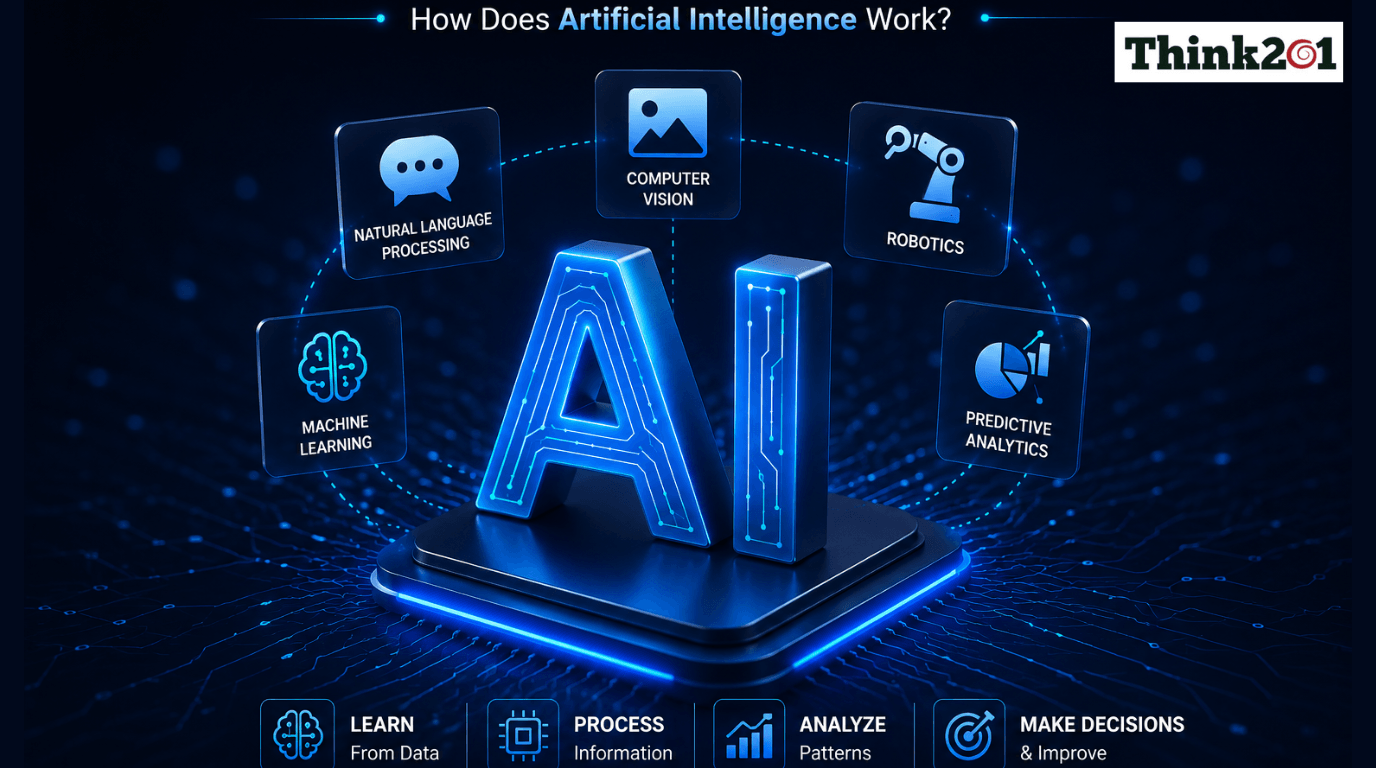
Artificial Intelligence (AI) has emerged as one of the most significant changes in the digital age. From voice assistants that answer questions to recommendation systems that suggest products and content, AI is shaping the way people use technology in their daily lives. Many businesses are also leveraging AI to automate everyday tasks, support better decision-making, offer tailored customer experiences, and create smarter products and services.
Despite its growing popularity, there is curiosity about how AI actually functions. Is it simply a system following instructions, or can it truly learn and make wise decisions? The truth lies in between. AI systems are designed to learn from data, detect patterns, and continually improve their performance rather than relying entirely on fixed instructions.
In this guide, we’ll explain how AI operates in easy-to-understand terms, explore the relationship between Artificial intelligence and data science, and explore some of the most common applications of AI that are reshaping industries globally.
What Is Artificial Intelligence?
Artificial Intelligence refers to the ability of machines or software to carry out tasks that usually require human intelligence. These tasks include understanding spoken or written language, recognizing images, solving problems, making predictions, learning from experiences, and producing content.
Unlike traditional software that executes a set of instructions, AI systems use algorithms and data to find patterns and make choices. Instead of being programmed for every possible scenario, they improve over time through learning from new data and user interactions.
Today’s AI includes several technologies, like machine learning, deep learning, natural language processing (NLP), and computer vision. Together, these technologies power applications such as virtual assistants, intelligent chatbots, recommendation systems, fraud detection platforms, self-driving cars, and medical diagnostic tools.
AI is no longer only for large tech companies. Organizations of all sizes are using AI to automate tasks, study customer behavior, enhance operational efficiency, and create personalized digital experiences.
How Does Artificial Intelligence Work?
At its core, AI functions by collecting data, discovering patterns, making predictions, and consistently improving through learning. Unlike traditional software, which depends on fixed instructions, AI systems analyze large volumes of information to spot connections and make informed decisions.
The process starts with data. AI models require examples to learn, whether they interact with customers, images, financial records, sensor data, or text files. High-quality data is vital because it directly affects the accuracy and reliability of the AI system.
After data is gathered, it is cleaned and organized before being used to train an AI model. During training, the model studies thousands or millions of examples to detect patterns. For instance, an AI system that detects fraudulent transactions learns to detect suspicious activities by examining historical transaction data.
Once trained, the model is tested using new data that it has not previously seen. This step ensures the AI can make accurate predictions in real-world scenarios rather than just memorizing the training data. After validation, the AI model is implemented into websites, mobile apps, enterprise software, or cloud platforms where users can interact with it.
Unlike traditional software, AI continues to learn after deployment. As users interact with the system and new data is available, developers monitor its performance, retrain the model if needed, and optimize its responses. This ongoing learning process helps AI applications become more accurate and effective over time.
Artificial Intelligence and Data Science
Artificial intelligence and data science are related, yet distinct. Data science focuses on gathering, organizing, analyzing, and interpreting data to find valuable insights. AI uses this data to build systems capable of making predictions, automating tasks, and aiding decision-making.
Imagine data science as the foundation and AI as the application. Without quality data, even the most advanced AI models cannot work well. Data scientists prepare and organize information, while AI engineers use data to create intelligent systems that solve business challenges.
For example, an e-commerce business might use data science to collect customer browsing history, purchase behavior, and product ratings. AI then uses this information to recommend products that each customer is likely to buy. Similarly, banks analyze transaction data to detect fraud, and healthcare providers use patient records to assist doctors in faster and more accurate diagnoses.
As companies generate more data, the integration of Artificial Intelligence and data science is becoming more crucial. Together, they help businesses make better decisions, improve customer experiences, and identify new areas for growth.
Applications of Artificial Intelligence
The use of AI is expanding across almost every industry. Rather than replacing human expertise, AI helps organizations work more efficiently by streamlining repetitive tasks, analyzing data quickly, and delivering useful insights.
In customer service, AI-powered chatbots answer frequently asked questions, solve support requests, and offer assistance 24/7. This speeds up response times and allows human agents to focus on more complex customer issues.
Healthcare organizations use AI to analyze medical images, assist in diagnosing diseases, and suggest personalized treatments. By quickly processing large volumes of medical data, AI helps doctors make faster and more informed decisions.
Financial institutions use AI to spot unusual transaction patterns, detect fraud, evaluate credit risk, and automate compliance. These functions improve security and reduce the need for manual work.
Retail and e-commerce companies use AI to recommend products, predict demand, optimize inventory, and tailor shopping experiences. AI-driven recommendation engines increase customer engagement and improve sales by suggesting products based on browsing history and purchase behavior.
Manufacturing companies implement AI for predictive maintenance, product quality checks, and process optimization. By identifying equipment issues before they cause failures, AI reduces downtime and improves efficiency.
Marketing teams also benefit from AI through audience segmentation, campaign optimization, content creation, and customer behavior analysis. AI helps marketers deliver more relevant messages while using advertising budgets more efficiently.
These examples show that AI is no longer a specialized technology. It has become a powerful business tool that helps organizations innovate, improve efficiency, and provide value to customers across various sectors.
Difference Between Artificial Intelligence and Human Intelligence
Although AI can process data and perform complex tasks quickly, it is quite different from human intelligence. AI learns from patterns in data and follows algorithms to make decisions, whereas humans use reasoning, emotions, creativity, ethics, and life experiences.
For instance, an AI system can review thousands of customer reviews in minutes and identify common themes. But it cannot truly understand emotions or apply human judgment in sensitive situations. People possess the ability to think creatively, adapt to unfamiliar problems, and make decisions based on intuition qualities that AI cannot fully replicate.
Rather than replacing humans, AI is best seen as a tool that enhances human capabilities. By handling repetitive and data-heavy tasks, AI allows people to focus on innovation, planning, and relationship building.
Artificial Intelligence Future
The future of AI is very promising as more businesses incorporate AI into their daily operations. Progress in areas like generative AI, autonomous AI agents, robotics, and multimodal AI is making technology more intelligent, accessible, and capable of handling complex problems.
In the years ahead, AI is expected to play a bigger role in healthcare, education, manufacturing, finance, retail, and transportation. Businesses will not only use AI to automate routine tasks but also to support better decision-making, personalize customer interactions, improve processes, and speed up product development.
However, the future of AI is not just about technological growth. Responsibly using AI, protecting data privacy, ensuring cybersecurity, and developing AI ethically will be equally important. Companies that responsibly adopt AI while being transparent and protecting user data will be better equipped to build trust and achieve long-term success.
Final Thought
Artificial intelligence is changing the way organizations operate by making technology smarter, faster, and more efficient. From automating tasks to supporting intelligent decision-making, AI has become a vital tool for companies aiming to innovate and stay competitive. Understanding how AI works is essential for finding opportunities where it can deliver real business value.
As AI continues to advance, businesses should focus on implementing solutions that match their goals while ensuring responsible and secure use. Whether it’s developing AI-powered apps, intelligent chatbots, or automating workflows, the right AI strategy can improve productivity, enhance customer experiences, and support long-term growth.
At Think201, we help organizations turn AI concepts into practical, scalable solutions. From AI-enabled web and mobile applications to intelligent automation and custom AI development, our team works closely with businesses to create digital experiences that solve real problems and support sustainable growth.
Frequently Asked Questions
What is artificial intelligence primarily focused on?
Artificial intelligence enables machines to perform tasks that normally require human intelligence, such as learning, reasoning, problem-solving, language understanding, decision-making, and recognizing patterns in data.
What kind of environment is strategic in artificial intelligence?
A strategic environment in artificial intelligence is one where decisions influence future outcomes and require planning, prediction, and adaptation. Examples include autonomous vehicles, financial trading, supply chain optimization, and business decision-making systems.
Which are common applications of deep learning in artificial intelligence?
Deep learning is widely used for image recognition, speech recognition, natural language processing, recommendation systems, autonomous driving, medical image analysis, and generative AI applications like text and image generation.
How can you stay safe while using AI tools online?
Protect your privacy by avoiding the sharing of sensitive information, using trusted AI platforms, verifying AI-generated responses, enabling strong account security, and regularly reviewing privacy settings.
Can artificial intelligence replace human intelligence?
No. AI can automate tasks, analyze large datasets, and improve efficiency, but it lacks human creativity, emotional intelligence, ethical reasoning, and common sense. AI is designed to assist humans rather than replace them.
Why is artificial intelligence important for businesses?
Artificial intelligence helps businesses automate repetitive tasks, improve customer experiences, analyze data faster, reduce operational costs, and make more informed decisions, giving them a competitive advantage in today’s digital economy.