How Nonprofits Can Leverage Technology Consulting to Maximise Impact

Many nonprofits know they need better systems, smoother workflows, and clearer data. They feel the pressure to work faster and show results, but they often do not have the time or clarity to choose the right tools. Technology can make an organisation stronger, but only when it is planned with intention. Otherwise, it simply becomes another burden on an already stretched team.
This is where non profit technology consultants come in. They help organisations understand what they truly need, instead of pushing tools that only solve a small part of the problem. Good consulting gives nonprofits confidence to make decisions that support their mission, not distract from it.
What Technology Consulting Actually Means for Nonprofits
Technology consulting for nonprofits is not about selling software or building a large system from day one. It is a process of understanding your organisation, mapping your challenges, and guiding you towards the right solutions in a clear and practical way.
In simple terms, a consultant helps you:
- Understand what is not working in your current setup
- Identify which parts of your work can be improved with technology
- Plan your digital roadmap
- Choose the right tools
- Avoid unnecessary spending
- Build systems that actually match your operations
It is about clarity, not complexity. When done well, it keeps you in control of your decisions.
Why Technology Consulting Matters More Today
Many nonprofits feel they are being pushed into the digital world quicker than they expected. This shift is not a trend. It is a reflection of how programmes now run and how stakeholders interact.
These changes make consulting more valuable today:
1. Remote and hybrid work
Teams are spread out and need consistent systems.
2. Digital service delivery
Beneficiaries access programmes online, so workflows need to be clear.
3. Rising reporting and compliance needs
Funders want accurate, timely data.
4. Growing donor expectations
Donors appreciate transparency and well-organised communication.
5. Increasing scale and data complexity
Spreadsheets alone cannot support larger or multi-location programmes.
A non-profit technology consultant helps an organisation respond to these changes without getting overwhelmed.
Common Challenges Nonprofits Face Without the Right Tech Guidance
Many nonprofits operate with good intentions but underprepared systems. Over time, this leads to stress, confusion, and unnecessary workload.
Here are the problems we see often:
1. Scattered tools
Different teams use different systems that do not connect.
2. Manual and repetitive workflows
Most tasks require phone calls, emails, or spreadsheets.
3. Poor visibility into data
Leaders cannot see impact clearly or make decisions based on reliable information.
4. Budgets wasted on the wrong tools
Organisations often buy software that is not built for their needs.
5. Difficulty scaling programmes
Growth becomes harder because systems are not built to support it.
These challenges slow down your mission. Consultants help you fix the root cause instead of adding another tool that complicates the workflow further.
How Non Profit Technology Consultants Help
A good consultant approaches your organisation like a partner, not a vendor. The goal is to understand your mission and make technology work around it.
Here are the most valuable areas where consultants support nonprofits:
1. Workflow mapping
Understanding how your team works in real life, not just on paper.
2. Identifying the real problem
Sometimes the issue is not technology. It might be unclear processes or duplicated tasks.
3. Recommending the right tools
This includes checking if an existing tool can be used better, instead of suggesting a new one.
4. Helping evaluate vendors
Consultants help you compare vendors fairly and make decisions with confidence.
5. Designing custom systems only when needed
Custom development is recommended only when no tool fits your unique workflow.
6. Reducing long term costs
Clear planning prevents overspending on unnecessary features or complicated systems.
Consultants bring objectivity, something that is difficult for internal teams because they are too close to the day to day struggles.
Key Areas Where Technology Consulting Creates Impact
Almost every part of a nonprofit can benefit from thoughtful technology planning. These are the areas where consulting usually makes an immediate difference:
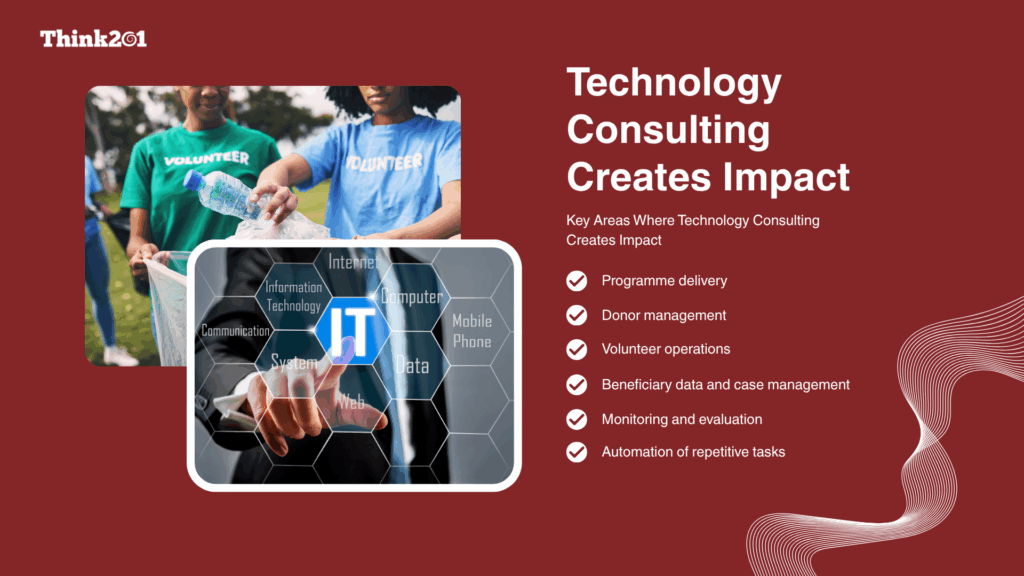
1. Programme delivery
Clear workflows make operations smoother and reduce friction for staff.
2. Donor management
Better tracking leads to stronger relationships and improved retention.
3. Volunteer operations
Scheduling, communication, and reporting become easier.
4. Beneficiary data and case management
Structured systems replace messy spreadsheets and repeated manual work.
5. Monitoring and evaluation
Consultants help design systems that collect data you can trust.
6. Automation of repetitive tasks
Small improvements save hours of work each week.
Consulting helps you build a strong operational backbone that supports long term impact.
How to Know If Your Organisation Is Ready for Tech Consulting
Not every organisation needs consulting immediately. Here are signs that you might be ready:
- Your team repeats the same manual tasks every week
- You rely heavily on spreadsheets that feel uncomfortable to manage
- You use multiple tools that do not talk to each other
- Reporting takes too long or does not feel reliable
- Your programme is growing and you feel stretched
- You are unsure what system to build or buy next
- You worry about the cost of making the wrong decision
If any of these feel true, consulting can save you time, money, and effort.
Choosing the Right Non Profit Technology Consultant
A consultant should feel like a thinking partner. Someone who listens first and recommends later.
Look for consultants who:
- Understand the nonprofit sector deeply
- Ask questions about your beneficiaries and workflows
- Avoid pushing tools without first mapping your needs
- Communicate in plain English
- Support you through implementation, not just planning
- Think long term, not short term
Good consulting is not about the number of features. It is about clarity, confidence, and sustainability.
Expected Costs and Timelines Explained Simply
Consulting costs depend on your scale, number of workflows, and complexity of your programmes. While it is an investment, it often prevents far larger costs caused by choosing the wrong system or building something you do not need.
Most nonprofits see value quickly because the clarity they gain helps them:
- Avoid unnecessary custom development
- Use their tools better
- Improve reporting accuracy
- Save hours of manual work
- Build sustainable systems that last
A good consultant helps you spend wisely, not more.
Final Thoughts
Nonprofits do not need to navigate technology alone. With the right guidance, digital systems can simplify your work, support your team, and strengthen your mission. When clarity comes first, decisions become easier and solutions become more sustainable.
If your organisation wants practical support from a partner who understands the nonprofit world, Think201 – the best tech company in bangalore, can help. We work as non profit technology consultants for NGOs, social enterprises, and TechforGood teams. Our approach is simple. We understand your workflow challenges and guide you to technology that truly strengthens your impact. If you want clarity before investing in any tool or platform, our team is here to support you.