Natural Language Processing in AI Applications
Quick Answer: Natural language processing (NLP) is a branch of artificial intelligence that helps computers understand, analyze, and generate human language. It powers chatbots, language translation, voice assistants, sentiment analysis, text summarization, and AI-powered search.
What Is Natural Language Processing?
Natural language processing (NLP) is a branch of intelligence that enables computers to work with human language. It helps software process written text and spoken words, identify patterns, interpret meaning, and generate responses.
People communicate using language, but computers work with numerical data and mathematical operations. NLP helps bridge this gap by converting language into a form that AI systems can analyze.
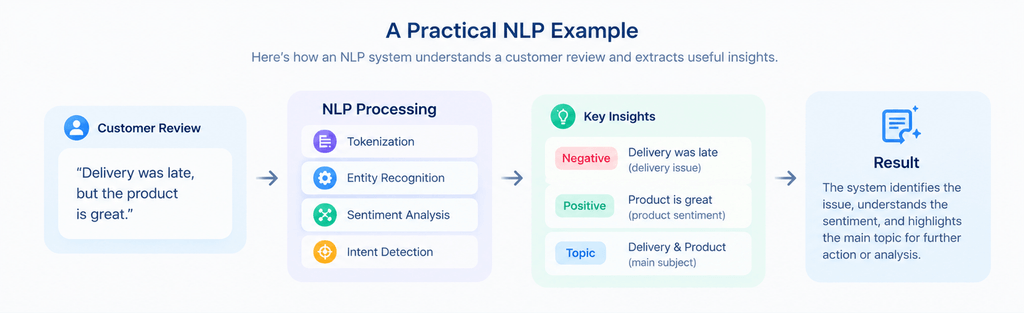
For example, a customer might write, “The delivery was late. The product is excellent.” An NLP system can identify the product feedback, recognize the negative opinions, and classify the message for further analysis.
Natural language processing in AI is used across customer service, healthcare, finance, education, e-commerce, and many other industries. It helps businesses extract information from emails, documents, reviews, conversations, and other language-based data.
Modern NLP also supports language models (LLMs) and generative AI applications, enabling more flexible conversations and content generation. However, the accuracy of these systems depends on the model, data, task, and context.
How Does Natural Language Processing Work?
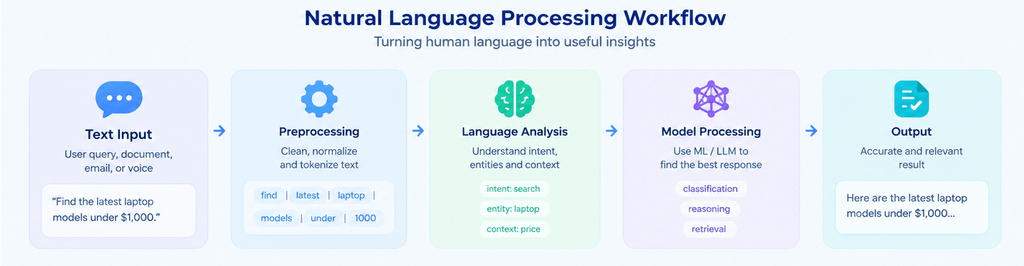
NLP systems use techniques to process language and produce useful results. The exact workflow depends on the application. Most systems follow a few common stages.
1. Collecting Text or Speech
The system first receives language input. This could be a customer message, an email, a document, a voice command, or a product review.
If the input is spoken, speech recognition may convert it into text before processing.
2. Cleaning and Preparing the Data
Text can contain spelling mistakes, unnecessary symbols, inconsistent formatting, and other elements that make analysis difficult.
Preprocessing prepares the text for the task. It may include splitting sentences into units, standardizing text, removing unwanted characters, and converting words into their base forms.
3. Analyzing Language
The system examines the structure and meaning of the text. Depending on the task, it may identify roles, recognize names and locations, detect sentiment, or determine the user’s intent.
For example, a customer support chatbot may recognize that “I need to change my delivery address” is a request to update an order.
4. Converting Language Into Numerical Representations
Machine learning models need representations of language. NLP systems can convert words or text into features or embeddings that help models identify patterns and relationships.
Modern models can also represent words based on their surrounding context, which helps distinguish meanings of the same word.
5. Producing an Output
Finally, the system produces a result based on its purpose. It might classify a message, translate a sentence, summarize a document, answer a question, or generate a response.
This output can then support another application or trigger a business workflow. These stages may be repeated. Repeat in advanced NLP systems.
Types of Natural Language Processing
There are ways to classify NLP. One common approach is to group systems by how they process language, while another focuses on the tasks they perform.
1. Rule-Based NLP
Rule-based NLP uses predefined rules, dictionaries, and patterns to process language. Developers specify how the system should respond to words or sentence structures.
For example, a basic system might identify messages containing “refund”. It directs them to a refund-related category.
This approach works well for predictable tasks. However, it can struggle when users express the idea in unexpected ways.
2. Machine Learning-Based NLP
Machine learning-based NLP learns patterns from data, rather than depending entirely on manually written rules. Models can be trained to classify messages, detect sentiment, recognize entities, and perform language tasks.
Learning and transformer-based models have expanded NLP capabilities by learning more complex relationships in language.
Many modern applications combine learned models with rules, databases, and other techniques. The right approach depends on the task, data availability, accuracy requirements, and cost.
Common NLP Tasks and Techniques
NLP includes techniques that help AI systems process language.
- Tokenization: Breaks text into units, such as words, subwords, or sentences.
- Part-of-speech tagging: Identifies roles, such as nouns, verbs, and adjectives.
- Named entity recognition: Identifies names of people, organizations, locations, dates, and other entities.
- Sentiment analysis: Identifies opinions or emotional tone in text.
- Text classification: Assigns categories to messages, documents, or other text.
- Machine translation: Converts text from one language into another.
- Text summarization: Creates a version of a longer piece of content.
- Question answering: Finds or generates answers to user questions.
These techniques often work together. For example, a customer feedback system may classify a review, identify the product being discussed, and analyze whether the customer expresses negative sentiment.
Uses of Natural Language Processing in AI Applications
Natural language processing is already part of everyday digital experiences. Its value comes from helping software work with language by requiring users to interact only through menus, forms, or fixed commands.
1. AI Chatbots and Virtual Assistants
NLP helps chatbots interpret questions, identify user intent, and respond in a way.
For example, a customer might ask, “Can I return the shoes I bought this week?” An NLP-powered chatbot can recognize the return request. Guide the customer through the next steps.
Advanced chatbots can also use large language models, business data, and connected tools to provide relevant answers or complete specific tasks.
2. Language Translation
Translation tools use NLP to convert text between languages while attempting to preserve meaning and context.
Businesses use translation to make websites, product information, support content, and documents accessible to people who speak different languages.
However, idioms, cultural references, regional expressions, and specialized terminology can still make accurate translation difficult.
3. Sentiment Analysis
Sentiment analysis helps businesses understand opinions expressed in reviews, surveys, social media posts and support conversations.
For example, an e-commerce company can analyze thousands of product reviews to identify complaints about product quality, delivery, or customer service.
These insights help teams recognize recurring issues and understand customer expectations.
4. Search Engines and Information Retrieval
NLP helps search systems interpret what users mean rather than relying only on exact keyword matches.
For example, a user searching for “ways to reduce electricity bills” may receive useful information even if the page uses phrases such as “lower household energy costs.”
Businesses can also use NLP to improve search across documents, reports, support articles, and company knowledge bases.
5. Email Filtering and Text Classification
Email systems use NLP and related machine learning techniques to classify messages, identify spam, and organize communication.
Businesses can apply methods to sort customer requests into categories such as billing, technical support, sales, or account access.
This helps teams prioritize work and reduces the need to manually review every message.
6. Text Summarization
NLP can turn documents into shorter summaries that highlight important information.
Employees can use summarization tools to review reports, meeting notes, research papers, and customer conversations quickly.
However, summaries should be checked when important decisions depend on details since a system may omit relevant information or misrepresent the original meaning.
7. Document Processing and Data Extraction
Businesses receive amounts of information through contracts, invoices, applications, emails and reports.
NLP can identify details such as names, dates, amounts, addresses, and key terms. These details can then be organized for search, analysis, or workflow automation.
For example, an insurance company may use NLP to identify information in a claim document before a human reviewer evaluates the case.
8. Voice Assistants and Speech Applications
Voice assistants combine speech recognition with NLP to process spoken commands and questions.
A user might ask for directions, set a reminder, or request information using language. The system interprets the request. Responds or acts.
Voice applications can also support accessibility and hands-free interaction, although background noise, accents, and speech variations can affect accuracy.
These examples show how NLP can support both everyday tools and complex business applications.
Benefits of Natural Language Processing
NLP offers several practical benefits for businesses.
Information processing: NLP can analyze large volumes of text more quickly than manual review alone.
Better customer experiences: Chatbots, search tools, and virtual assistants make it easier for users to find information and get support.
Repetitive work: Text classification, document extraction, and automated responses can reduce routine manual tasks.
Useful business insights: Sentiment analysis and text analytics help teams understand customer feedback and identify recurring patterns.
Access to information: NLP helps users search documents and ask questions using natural language.
Communication support: Translation and multilingual language systems can help businesses serve users across different languages.
These benefits depend on choosing the right use case and evaluating the system’s performance. NLP is not automatically accurate, and sensitive or high-impact decisions may still require review.
Challenges of Natural Language Processing
Human language is complex. NLP systems do not always interpret it correctly.
- Ambiguous meaning: The same word can mean things depending on the sentence. Sarcasm and indirect expressions can also be difficult to interpret.
- Data quality: Incomplete, outdated, or biased training data can affect results.
- Language variation: Dialects, slang, spelling mistakes, and regional expressions can reduce accuracy.
- Privacy and security: Processing customer messages, financial information, or personal documents requires safeguards.
- Context and factual accuracy: A model may misunderstand a request. Generate an incorrect answer, especially when it lacks reliable context.
Businesses can reduce these risks through data, task-specific testing, clear system boundaries, human review, and ongoing monitoring.
The Role of NLP in Modern AI Development
Natural language processing is a part of modern AI development because it allows applications to interact with people through language.
It works alongside technologies such as machine learning, deep learning, large language models, retrieval-augmented generation (RAG), and speech recognition. Each technology serves a purpose, but they can be combined to create more capable applications.
For example, an AI assistant might use natural language processing to interpret a question, retrieval-augmented generation to retrieve information from company documents, and a large language model to generate a response based on that information.
Businesses planning an AI application should first identify the language-related problem they want to solve. They can then select the natural language processing techniques, data sources, models, and integrations.
The aim is to create a reliable application, not simply to add AI features without a clear purpose.
Final Thoughts
Natural language processing helps bridge the gap between communication and computer systems. From chatbots and translation tools to document analysis and AI assistants, it allows applications to work with language in useful ways.
As AI continues to evolve, natural language processing will remain a part of building applications that can process information, respond to questions, and support business workflows.
Think201 helps businesses turn AI ideas into digital solutions. If you are planning an AI-powered chatbot, virtual assistant, or language-based application, connect with the Think201 team to explore the approach for your business.
Frequently Asked Questions
1. What is natural language processing and how is it used in AI?
Natural language processing is a branch of AI that helps computers analyze, understand, and generate human language. It is used in chatbots, translation tools, voice assistants, sentiment analysis, text summarization, search systems, and document processing.
2. What are the steps of natural language processing in AI?
A typical NLP workflow includes collecting text or speech, cleaning and preparing the data, analyzing language, converting text into numerical representations, processing it with a model, and producing an output. The exact steps vary depending on the application.
3. What are the 2 types of NLP?
Two commonly discussed approaches are rule-based NLP and machine learning-based NLP. Rule-based systems follow predefined rules, while machine learning-based systems learn patterns from data. Some applications combine both approaches.
4. Which AI technology is used for natural language processing?
NLP uses several AI technologies, including machine learning, deep learning, neural networks, and transformer models. Depending on the task, it may also use large language models, speech recognition, and word or text embeddings.
5. What are the 7 levels of NLP?
A commonly used educational classification describes seven linguistic levels:
- Phonetics and phonology: The sounds and sound patterns of language.
- Morphology: How words are formed from smaller units.
- Lexical analysis: How individual words are identified and interpreted.
- Syntax: How words are arranged into sentences.
- Semantics: The meaning of words, phrases, and sentences.
- Discourse: How meaning connects across multiple sentences.
- Pragmatics: How context and speaker intent affect meaning.