A Practical Guide to AI Agent Development
Ask ten business owners about what an AI agent is, and you’ll get ten different answers. Some picture a smarter chatbot. Others imagine an employee running the company while they sleep. The truth sits in between, and understanding it can save you from both wasted budget and missed opportunity.
This guide explains what AI agents are, the main types of agents you’ll come across, what AI agent development actually involves, and why more businesses are moving from experiments to deployments. It also covers where agents go wrong because that part rarely makes it into the sales pitch.
What Are AI Agents?
If you’ve been searching for “what are AI agents, ” here’s the short version. An AI agent is software that can work toward a goal on its own. It takes in information, decides what to do, uses tools to act, and adjusts based on what happens.
Compare that with a chatbot. A chatbot answers “Where’s my order?” with whatever it knows. An AI agent checks the carrier’s system, notices the parcel is stuck, issues a credit within a limit you’ve set, and emails the customer an update. Same question, different outcome.
Three ingredients make this possible:
- A reasoning engine, a large language model, that interprets requests and plans steps.
- Tools, such as APIs, databases, your CRM, email, or a browser, that let the agent do things rather than say things.
- Memory and context so the agent remembers what it has already done and what the customer already told it.
Remove any one of these. You’re back to a chatbot or a script.
AI Agent vs. Chatbot vs. Rule-based Automation
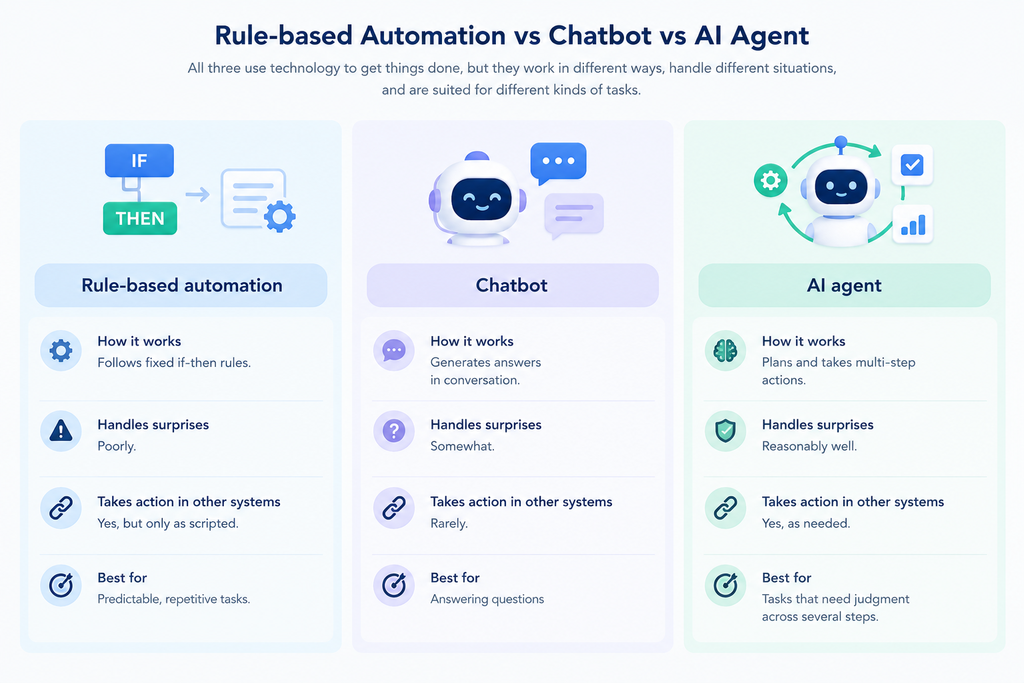
None of these is “better.” A simple automation is often the right answer, and we’ll come back to that.
How an AI Agent Actually Works
AI Agents run a loop that looks something like this:
- Perceive: Receive a request or trigger such as a new support ticket or an overdue invoice.
- Plan: Break the goal into steps. Decide which tools to use.
- Act: Call those tools, whether that means querying a database, drafting a reply, or updating a record.
- Review: Check the result, then either continue, try another approach, or hand off to a human.
That last step matters more than it sounds. A well‑built AI Agent knows when it is out of its depth and asks for help rather than guessing.
What Makes an AI Agent Different From Regular Software
Software does what it was told, the same way every time. An AI Agent shows traits that set it apart:
- Autonomy: It chooses its next step without waiting for instructions at every turn.
- Goal focus: It judges its actions by whether they move it closer to an outcome, such as balancing delivery speed against cost.
- Awareness: It pulls information from APIs and databases so it notices when something changes.
- Initiative: It can act before being asked, like reaching out to a customer who seems frustrated before a ticket is ever filed.
- Adaptability: It adjusts as circumstances shift and improves its feedback.
- Collaboration: It can hand off work to agents or to people.
You will not need all of these on day one. A useful first AI Agent often shows two or three.
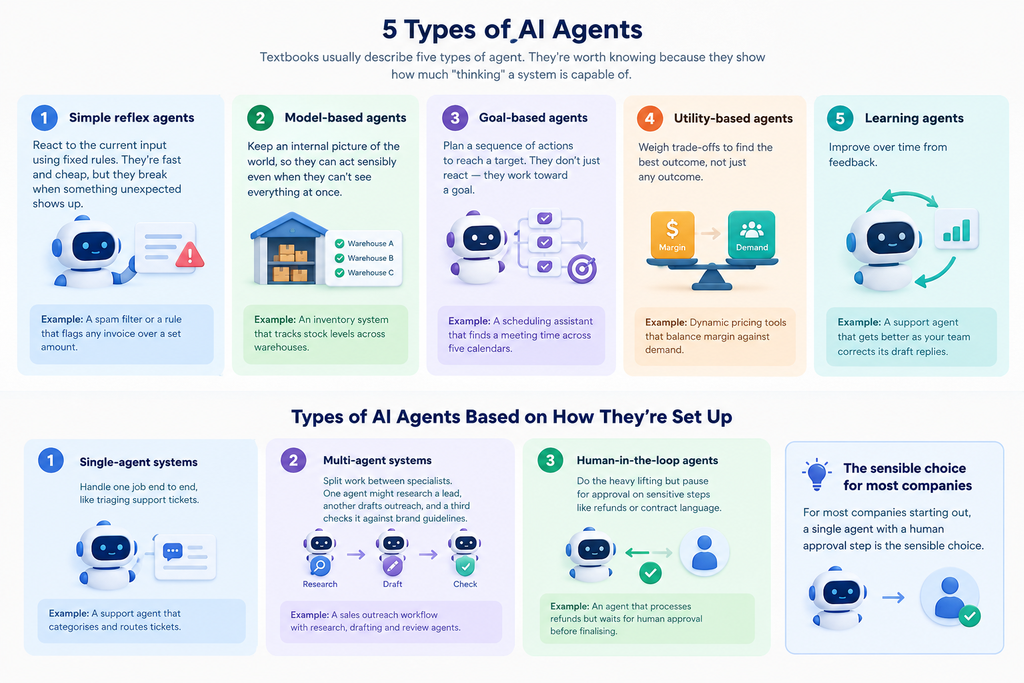
Types of AI Agents
The types of AI Agents are:
- Simple reflex agents: React to inputs using fixed rules.
- Model-based agents: Track the current state to make informed decisions.
- Goal-based agents: Plan actions to achieve a specific goal.
- Utility-based agents: Compare options to find the best outcome.
- Learning agents: Improve their performance through feedback.
What AI Agent Development Involves
AI agent development is less about writing code and more about careful design. A typical project looks like this:
- Define one job. “Handle customer service” is too vague. “Resolve order‑status and return questions under a set value” is workable.
- Choose the model and architecture. Larger models reason better, but cost more per call. Smaller ones are cheaper and faster, for steps.
- Connect the tools. This is where most of the effort goes. Agents are only as useful as the systems they can reach, and older systems with poor APIs cause the most delays.
- Add guardrails. Set spending limits, approval steps, restricted actions. Log everything the agent does.
- Test on cases. Use messy real examples from your history, not tidy demos.
- Refine. Review where the agent struggled, fix those cases, and expand the agent’s scope.
Teams often underestimate the two. The first version of an agent usually works well as a new hire on day one, promising but in need of supervision.
How to Tell Whether Your Agent Is Actually Working
Demos flatter agents. Measurement separates a pilot that scales from one that quietly stalls. Teams typically track:
- Task completion rate: how often the agent finishes the job correctly without help.
- Error and escalation rate: how often the agent gets things wrong or has to hand off.
- Speed: response time and time to resolution.
- Safety checks: whether the agent can be tricked by instructions hidden in a message and whether the agent treats different customers fairly.
- User satisfaction: for customer-facing agents, how people rate the agent’s experience.
Test against a set of cases the agent never saw while the agent was being tuned, and run those tests in a sandbox before real customers get near the agent.
Add security from the start: limit what the agent can access, require authentication, and encrypt sensitive data.
Why Businesses Need AI Agents
“Need” is a word, so let us be precise. Not every business needs an agent today. Many have problems that the agent is unusually good at solving.
Fewer handoffs. In companies, work stalls between systems and between people. Someone copies data from the CRM into a spreadsheet, then emails finance, then waits. The agent can carry a task across those gaps without waiting.
Scale without adding headcount. When ticket volume doubles during a sale, the agent can absorb much of the increase. Your team handles the exceptions instead of the routine.
Round-the-clock coverage. Customers and suppliers do not keep your office hours. The agent can respond, qualify, and route at any time.
Consistent quality. The agent follows the process on the thousandth case as on the first, which makes reporting and compliance simpler.
More time for judgment work. The strongest argument is not replacing staff. It is letting skilled people spend their time on negotiation, complex problems, and relationships rather than data entry.
There is also an angle. As more companies adopt AI agents, customers will come to expect more personalized responses. Waiting until the pressure is obvious usually means catching up from behind.
Where AI Agents Deliver Value
- Customer support: triaging tickets, drafting replies, resolving requests, and escalating complicated ones with a summary already written.
- Sales: researching a lead before a call, updating the CRM afterward, and drafting follow‑ups.
- Finance and operations: matching invoices to purchase orders, resolving discrepancies and chasing missing documents.
- HR and IT: answering policy questions, onboarding hires and resetting access.
Notice the pattern. Each of these is repetitive, spanning systems, and still needs a little judgment. That combination is where the agent shines.
What Results Are Companies Reporting?
Numbers help, as long as you treat them as examples rather than promises. Published BCG client work includes:
- Marketing analytics: a consumer goods company turned a reporting job that once took six analysts into a one‑person task, with the agent finishing in under an hour.
- Customer service: a global bank reported 10x lower costs using AI agents to handle customer interactions.
- Content: a packaged goods company cut blog production costs by 95% and went from four weeks per post to a single day.
- Legacy IT: one IT department reported productivity gains of up to 40% while modernizing systems.
BCG also expects the AI agent market to grow 45% a year over the next five years. These results come from well‑scoped projects with people reviewing the output, so your own numbers will depend heavily on the task you pick.
What Can Go Wrong
Honest guidance should include the downsides.
- Confident mistakes. The agent can act on an assumption without any hesitation. Approval steps for high‑stakes actions are essential.
- Cost can grow quickly. Many model calls in a row add up. Keep a record of the cost for each task from the start.
- Integration can be tough. Linking to software is often slower and more expensive than the AI itself.
- Bad data is a problem. If your product information or customer records are messy, the AI agent will copy that mess.
- Unclear ownership hurts quality. Someone in your company must review the AI agent’s output, otherwise, quality will slip away.
How to Get Started
Choose one process that repeats clearly. Is low risk. Ask these four questions:
- Does it need judgment, not rules?
- Can the AI agent access the data and tools it needs?
- What does a mistake cost?
- How will we measure success?
If you can answer those questions clearly, run a pilot where a human reviews the AI agent’s output. Measure how much time is saved, the error rate, and the cost for each task. Expand only what really works.
Build versus buy: ready‑made platforms are good for tasks such as support and scheduling, and they get you up quickly. Building a custom AI agent is worth it when your workflows are unique, your data is sensitive, or the AI agent must connect deeply to your systems.
Final Thoughts
AI agents are not magic. They are not hype either. They are a way to take routine multi‑step work off your team’s plate as long as you pick the right task, put guardrails in place, and keep people involved where it matters. Start small, measure honestly, and let results, not buzzwords, decide how far you go.
Looking for an AI development company? Pick a partner that starts with your workflow, not with technology. Pick one that scopes a measurable use case, builds in human approval steps, and shows real results before you scale.
Think201 will help you decide if an AI agent is the right fit, what it would take to build, and where to start. Contact Think201 today to turn your idea into a working AI agent.
Frequently Asked Questions
How is an AI agent developed?
Development usually follows seven stages: set the goal and scope, design the architecture, choose the framework, model, and tools, build, train or tune, evaluate, then deploy and monitor. Most teams start from a pretrained model rather than training one from scratch.
How can I build my AI agent?
Start with one narrow, well-defined task. Pick a model and a framework or platform, connect the tools the agent needs (APIs, databases, email), and add guardrails such as spending limits and human approval for risky steps. Then test on real cases before launching to users.
What are the types of AI agents?
The five classic types are simple reflex, model-based reflex, goal-based, utility-based, and learning agents. Two more are often added for larger systems: hierarchical agents, where higher-level agents delegate to lower-level ones, and multi-agent systems, where several agents collaborate toward a shared goal.
Can I build AI agents without coding?
Yes, for simple use cases. No-code and low-code platforms let you create lightweight agents that connect to common business tools using visual builders or plain-language instructions. For complex workflows, custom integrations, or sensitive data, you’ll likely still need developers.
Sources Referred
https://www.ibm.com/think/topics/ai-agent-development
https://www.bcg.com/capabilities/artificial-intelligence/ai-agents