AI Vision Development for Enterprises
What Is AI Vision Development?
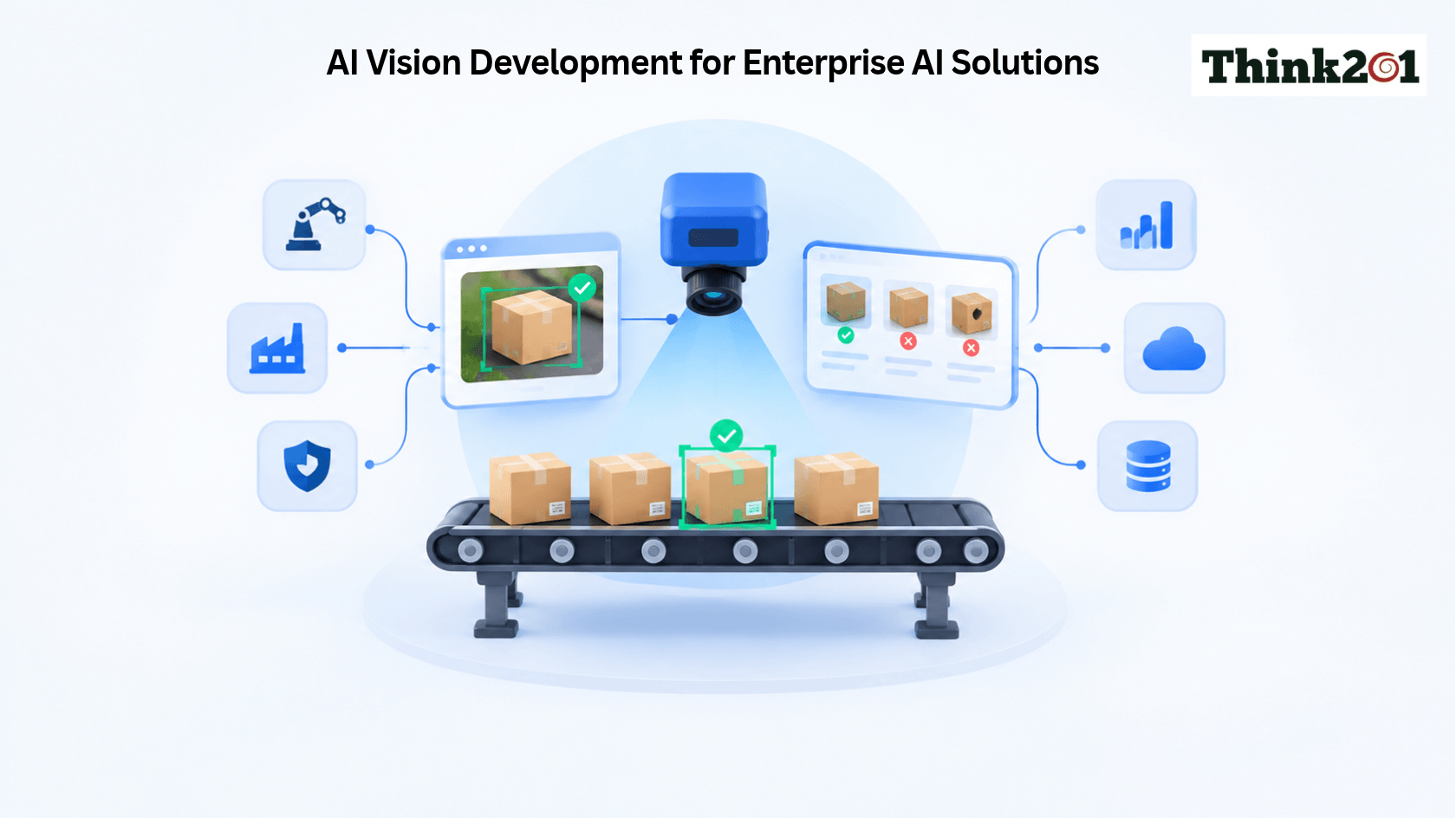
AI vision development is the work of creating AI systems that can read and analyze information, like images, videos, and camera feeds. It uses computer vision, machine learning, and deep learning to help software spot objects, find patterns, and understand what is happening in a scene.
For example, a manufacturing company can use an AI vision system to check products on a production line. The system can spot scratches, missing parts, or other visible defects and warn the team when a product needs inspection.
Traditional computer vision systems often rely on fixed rules to spot patterns. Modern AI vision systems can learn from training data. Recognize more complex patterns depending on the model and use case.
For enterprises, AI vision development is not about building an image recognition model. It also involves gathering data, picking the right technology, linking the system to business applications, testing its accuracy, and maintaining it after launch.
The goal is to turn information into useful business insights and actions.
Why Is AI Vision Important for Enterprises?
Enterprises create large amounts of visual data from cameras, production equipment, medical imaging systems, warehouses, retail stores, and other sources. Looking at all this information by hand can take a long time and may lead to inconsistent results.
AI vision helps businesses process data on a large scale. It can check products, track inventory, spot activity, and support decisions that rely on visual information.
For example, a logistics company can use cameras and AI vision to spot damaged packages. A retailer can analyze shelf images to find products. A manufacturer can check thousands of components during production.
AI vision also works with enterprise AI technologies. A company might combine computer vision with analytics to spot equipment problems or use a chatbot to explain inspection results to employees.
These applications make AI vision valuable for enterprises that want to improve efficiency, product quality, safety, and operational visibility.
Key Applications of AI Vision Development in Enterprises
1. Manufacturing and Quality Inspection
Manufacturing is one of the uses for AI vision. Inspection teams often need to look at products for defects, wrong assembly or missing parts.
An AI vision system can study images from cameras along a production line. It can flag defects and send the results to a quality management system. This helps manufacturers spot problems earlier and cut down on manual inspection. Human reviewers may still be needed for cases or quality decisions that need more context.
2. Retail and Inventory Management
Retailers can use AI vision to watch shelves, spot product spaces, and compare visible stock with expected inventory.
For example, a store can use camera images to spot products that need restocking. The system can alert staff so they can fix the issue sooner.
AI vision can also help with product recognition and store operations. However, applications that use customer images must have privacy safeguards.
3. Healthcare and Medical Imaging
AI vision can help healthcare professionals look at images, such as X‑rays, scans, and other diagnostic images.
Depending on the application and how validation there is these systems can highlight patterns that may need closer look. They can support clinicians. Should not replace professional judgment or established clinical procedures.
Healthcare AI vision systems need testing, proper data handling, and compliance with relevant regulations.
4. Logistics and Warehousing
Warehouses deal with volumes of packages, products, and inventory. AI vision can help identify items, check package conditions, read labels and support automated sorting.
For example, a logistics company can use computer vision to spot damaged packages before dispatch. Another company may use recognition to confirm that the correct items are packed into an order.
When linked to warehouse management systems, these features can cut checks and boost operational visibility.
5. Workplace Safety and Infrastructure Monitoring
Enterprises can use AI vision to spot visual conditions such as missing safety equipment, restricted‑area access, or objects blocking a designated path.
Infrastructure operators can also use analysis to check roads, buildings, equipment and other assets for visible signs of damage.
These systems should be designed for a defined purpose, with appropriate human oversight. Video monitoring may raise privacy concerns, so businesses should set access controls, retention rules, and limits on video monitoring use.
How Does AI Vision Development Work?
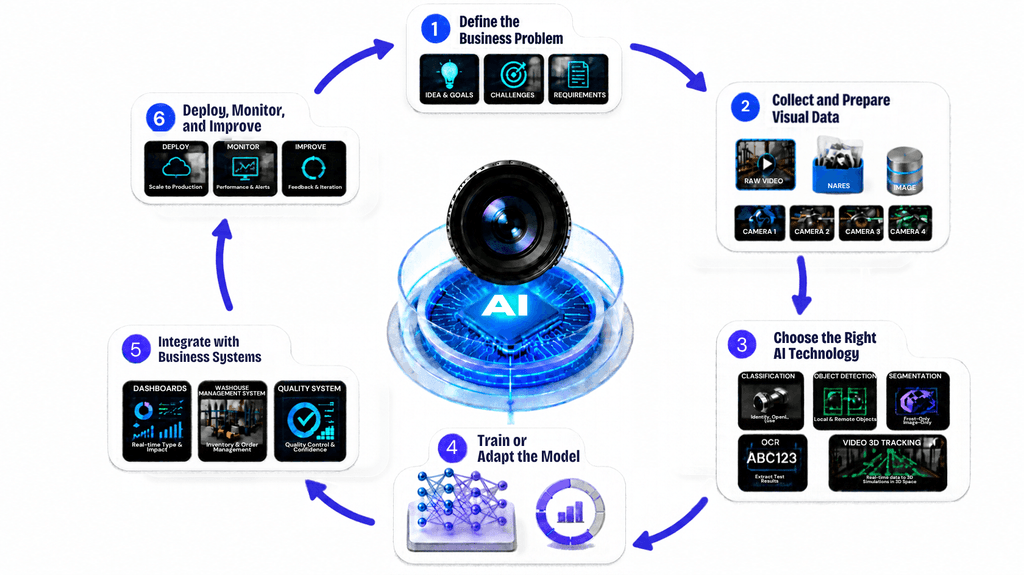
Building an enterprise AI vision solution involves several stages.
Step 1. Define the Business Problem
Start by identifying the task the system needs to perform. This could include detecting product defects, recognizing objects, counting items, or identifying unusual visual patterns.
A clear objective helps teams choose the right model and measure whether the solution delivers value.
Step 2. Collect and Prepare Visual Data
AI vision models learn from data. Businesses need images or videos that represent the conditions the system will encounter after deployment.
The data may need to be labeled so the model can learn which objects, defects, or patterns matter. Teams should also check image quality, data coverage, and potential bias.
Poor-quality or unrepresentative data can reduce accuracy in real-world conditions.
Step 3. Choose the Right AI Technology
The technology depends on the task.
Image classification identifies the category of an image. Object detection identifies and locates objects within an image. Image segmentation separates specific objects or regions from the background.
Some applications also use optical character recognition (OCR) to extract text from images, while others use video analysis to track objects or detect changes over time.
The best approach depends on the required accuracy, processing speed, available data, and operating environment.
Step 4. Train or Adapt the Model
Developers can train a model using relevant data or adapt an existing model to the enterprise’s requirements.
The team evaluates the model using data that was not used for training. This helps determine whether it can recognize the required patterns reliably.
Testing should include challenging conditions, such as different lighting, camera angles, product variations, and image quality.
Step 5. Integrate With Business Systems
An AI vision model becomes more useful when its output connects to existing enterprise applications.
For example, a defect detection system could send alerts to a quality management platform. A warehouse vision system could update inventory records or notify employees about damaged packages.
Integration allows visual insights to support real business workflows.
Step 6. Deploy, Monitor, and Improve
The system can run in the cloud, on local infrastructure, or on edge devices near the cameras or equipment.
After deployment, teams should monitor accuracy, processing speed, system availability, and error rates. Changes in products, environments, camera positions, or lighting may affect performance over time.
Regular evaluation and updates help keep the system useful as business needs change.
Benefits of AI Vision Development for Enterprises
AI vision can create value in different ways.
Visual inspection: AI vision can process many images quickly and flag cases that require attention.
Improved consistency: A tested AI vision model can apply the same inspection criteria to many items.
Reduced work: Employees can spend less time on routine visual checks and more time on complex tasks.
Operational visibility: Visual data can help businesses understand inventory conditions, production quality, and equipment status.
Support for decisions: Automated alerts and reports can help teams respond to problems sooner.
Scalable operations: Once validated, an AI vision system can often be extended to workflows or locations, although each new environment may need testing and adaptation.
These benefits depend on the use case, data quality, implementation, and the ability to integrate the AI vision system into operations.
Challenges to Consider Before Implementing AI Vision
Despite its potential, AI vision development comes with practical challenges.
Despite its potential, AI vision development comes with challenges.
Data quality and availability: The AI vision system needs images or videos. Missing examples and inconsistent labels can affect model performance.
Changing environments: Lighting, camera angles, product designs, and background conditions can influence results.
Integration complexity: Connecting AI vision to existing equipment and enterprise applications may require development.
Infrastructure costs: Cameras, computing resources, storage, deployment, and ongoing maintenance can add to the cost.
Privacy and security: Visual data may contain employees, customers, confidential processes, or sensitive information. Enterprises need safeguards and access controls.
Oversight: Incorrect detections can disrupt workflows or lead to poor decisions. Businesses should define when human review is required and how errors will be handled.
Planning for these challenges early can help enterprises avoid changes later.
How Much Does Enterprise AI Cost?
Enterprise AI costs vary based on the problem, data requirements, model complexity, integrations, deployment environment, and ongoing support.
An AI vision proof of concept that inspects a set of product images may cost much less than a production system that processes video streams across multiple factories.
Common cost factors include:
- Data preparation: Collecting, cleaning, and labeling images or videos.
- Model development: Training, adapting, and validating the AI vision model.
- Infrastructure: Cameras, computing resources, storage and cloud services.
- Integration: Connecting the AI vision solution to business applications and equipment.
- Maintenance: Monitoring performance, updating models, and resolving issues.
Businesses should estimate both development costs and the ongoing cost of running the AI vision system. A small proof of concept can help validate feasibility before committing to a rollout.
How Think201 Can Help With Enterprise AI Development
Building an enterprise AI solution requires more than selecting a model. Businesses need a clear use case, suitable data, a practical architecture, and a plan for integrating the AI vision technology into existing workflows.
Think201 can help businesses explore AI development opportunities, define requirements, and plan AI-powered applications around their needs.
For example, an enterprise solution could combine computer vision for inspection with analytics for reporting and a conversational interface for employee queries. Where needed, an AI development company can help build the component as part of a broader solution.
The right approach starts with understanding the business problem and choosing technologies that can solve it reliably.
Final Thoughts
AI vision development gives enterprises a way to turn images and videos into useful information. From manufacturing inspections to inventory management and infrastructure monitoring, AI vision can help businesses improve visibility, reduce work, and support faster decisions.
However, successful implementation depends on more than model accuracy. Enterprises need data, suitable infrastructure, integration with business systems, privacy safeguards, and continuous monitoring.
Start with one defined business problem, test the AI vision solution in a controlled environment, and expand when the results justify the investment.
Think201 helps businesses explore and build AI solutions that fit their needs. Contact the Think201 team to discuss your AI development goals and identify where AI can make a difference.
Frequently Asked Questions
1. What is the difference between generative AI and enterprise AI?
Generative AI creates content such as text, images, and code. Enterprise AI uses AI technologies to solve business problems, automate processes, and support decisions. Generative AI can be one component of an enterprise AI solution.
2. What does Enterprise AI do?
Enterprise AI helps businesses analyze data, automate repetitive tasks, improve forecasting, support customer service, detect problems, and make better decisions. Its applications include computer vision, predictive analytics, intelligent automation, and AI-powered assistants.
3. How expensive is Enterprise AI?
Enterprise AI costs depend on project complexity, data preparation, model development, infrastructure, integrations, and maintenance. A small proof of concept generally requires less investment than a production system deployed across multiple departments or locations. Businesses should evaluate total operating costs as well as initial development expenses.
4. What is AI vision used for in businesses?
AI vision helps businesses analyze images and videos for tasks such as quality inspection, object detection, inventory monitoring, document processing, and safety monitoring. The exact application depends on the industry and business requirements.
5. What is the difference between computer vision and AI vision?
Computer vision is the field focused on enabling computers to interpret visual information. AI vision commonly refers to solutions that use AI techniques, such as machine learning and deep learning, to perform visual tasks. The terms are often used interchangeably in business contexts.
Sources Referred
https://www.ibm.com/think/topics/enterprise-ai