Large Language Models Explained for Modern AI
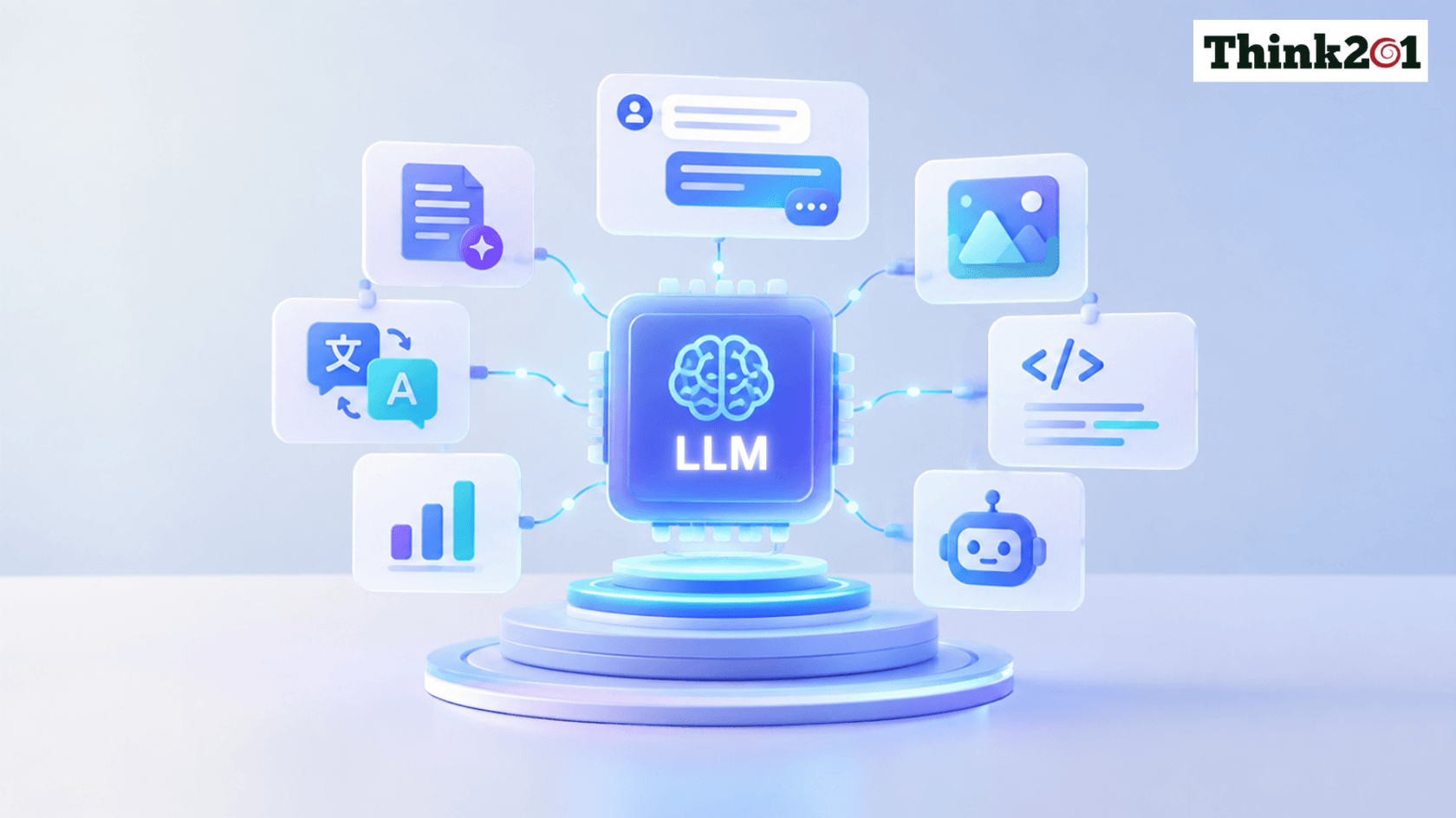
Artificial intelligence has evolved from basic rule-based systems to tools that can understand and respond to human language. A significant part of this progress is due to large language models (LLMs).
Today, people use LLMs when they ask an AI assistant a question, summarize a document, generate code, translate text, or draft an email. Businesses also use them to develop customer support assistants, knowledge tools, content management systems, and intelligent workflows.
But what exactly is an LLM, and why is it so useful?
A large language model is an AI model trained on vast amounts of text and other data so it can identify language patterns and generate helpful responses.
Modern LLMs are a core technology in many generative AI applications and are becoming essential in AI development.
What Is a Large Language Model?
A large language model is a type of deep learning model designed to process and generate human language. It learns patterns from large datasets and uses them to predict and create sequences of text.
The term “large” primarily refers to the scale of the training data and the number of parameters that the model uses. Parameters are internal values that the model modifies during training to improve its ability to produce useful outputs.
Unlike traditional software that follows a fixed set of instructions, an LLM can respond to different inputs in varied ways. The same model can summarize a report, answer a question, generate an email, explain code, or translate text.
This versatility is one reason LLMs have become central to modern artificial intelligence applications.
How Do LLMs Work?
It helps to think of an LLM as a system that learns patterns in language, rather than memorizing a collection of fixed answers.
The process starts with training data. This data can include books, websites, articles, documents, code, and other sources of text. Before training, the data is cleaned and processed so the model can learn from it more effectively.
The text is then broken into smaller units called tokens. A token can represent a complete word, part of a word, or sometimes a single character. The model processes these tokens and learns how they relate to each other.
During training, the model repeatedly tries to predict what comes next in a sequence. When its prediction is wrong, its internal parameters are adjusted. Through many training cycles, the model becomes better at recognizing language patterns.
For example, if a sentence starts with “The customer contacted support because…”, the model uses the surrounding context to estimate what words are likely to come next.
Modern LLMs commonly use transformer architectures, which rely on a mechanism called self-attention. This helps the model consider relationships between different parts of a sequence instead of treating each word separately.
Why Are Transformers Important for LLMs?
The transformer architecture played a key role in the development of modern LLMs. The architecture was introduced in the 2017 paper “Attention Is All You Need” and made it more practical to process large amounts of language data efficiently.
One of its important features is self-attention. It allows the model to determine which parts of the input are more relevant when processing a particular token.
For example, consider a sentence where a pronoun refers to something mentioned several words earlier. Understanding this relationship requires looking beyond the immediately preceding word. Self-attention helps the model capture these types of relationships.
Transformers also support parallel processing during training, which helped researchers build increasingly large models using large datasets.
How Are LLMs Trained?
LLM development generally happens in several stages, with pretraining being one of the most resource-intensive.
Pretraining
During pretraining, the model learns general language patterns from a very large dataset. It learns relationships between words, sentence structures, concepts, and other patterns in the data.
This stage gives the model broad capabilities but does not necessarily make it good at following specific user instructions.
Fine-Tuning
Developers can then fine-tune a model using a smaller, more focused dataset. This can help adapt the model for a particular task or domain, such as customer support, summarization, or specialized document processing.
Instruction Tuning
Instruction tuning helps a model become better at responding to requests in the way users expect. The training examples contain instructions and desirable responses, helping the model learn how to follow different types of prompts.
Human Feedback and Alignment
Human feedback can also be used to improve how models respond. Human evaluators may compare outputs and indicate which responses are more useful or appropriate. These signals can help improve the model’s behavior and alignment.
For most businesses, however, building an LLM from scratch is not necessary. Developers can use existing models through APIs or deploy suitable pretrained models and build applications around them.
How Do LLMs Generate Responses?
After an LLM has been trained, users interact with it by providing prompts. The model breaks down the input into smaller units known as tokens, processes them through its neural network, and predicts the most likely next token.
It continues this process until it forms a complete response. This process is fast, making the interaction feel natural and conversational.
Importantly, an LLM does not function like a traditional database that simply retrieves a stored answer. Instead, it creates an output based on the patterns and relationships it learned during training.
This is why the same prompt can sometimes result in slightly different responses.
LLM vs Generative AI
LLMs and generative AI are closely related, but they are not the same.
Generative AI refers to a broader category of artificial intelligence that can create new content in various forms, such as text, images, audio, video, or code.
An LLM is a specific type of AI model that focuses primarily on language-related tasks.
For instance, an application that generates articles or replies to customer inquiries might use an LLM as its underlying technology.
Other generative AI applications might use different models for generating images, audio, or video.
What Can LLMs Do?
The flexibility of LLMs allows developers to use them for a wide range of applications.
The versatility of large language models (LLMs) enables developers to apply them in a wide variety of applications.
Content Generation
LLMs can create drafts for emails, product descriptions, reports, articles, and other forms of written content.
Summarization
An LLM can process a long document and produce a shorter version that highlights the important information. This can help employees review reports, meeting notes, research, or customer conversations faster.
Question Answering
LLMs can power conversational interfaces where users ask questions using natural language instead of navigating through complex menus or search systems.
Code Assistance
Developers can use LLMs to generate code suggestions, explain existing code, create documentation, and identify potential issues. These outputs still require developer review and testing.
Translation
LLMs can support multilingual applications by translating text between languages and adapting content for different audiences.
Sentiment and Text Analysis
Businesses can use language models to analyze customer feedback, reviews, surveys, and support conversations to identify common themes or sentiment.
These use cases are already being applied across customer service, software development, education, finance, marketing, and other business functions.
How Businesses Use LLMs
For businesses, the main value of LLMs lies not in the model itself, but in the systems built around it.
For example, a company could connect an LLM to its internal knowledge base to create an assistant tool for employees. Instead of searching through multiple documents, employees can ask questions in natural language and get relevant answers.
A customer support team could use an LLM to summarize chats or offer suggested responses. A software team could use it to help with writing documentation and handling repetitive coding tasks.
This is where AI development plays a crucial role. Developers need to integrate the model with the right data, APIs, databases, user interfaces, access rights, and business processes.
What Is RAG and Why Does It Matter?
An LLM’s training data does not automatically include a company’s most recent internal information. This is where Retrieval-Augmented Generation (RAG) can help.
RAG connects an LLM with an external information source. When a user asks a question, the application first retrieves relevant information and then provides that information to the model as context for generating the response.
For instance, a company could link an LLM to its product documentation. When a customer asks about a specific product feature, the application can fetch the relevant documentation before generating the answer.
This approach makes an LLM more useful for business-specific tasks without requiring the model to be retrained whenever new information is available.
Challenges of Using LLMs
LLMs are powerful, but they have limitations.
One major challenge is hallucination, where the model creates convincing but incorrect information. Businesses should implement proper testing and safeguards when accuracy is critical.
Bias is another concern. Since LLMs are trained on large datasets, they can sometimes reflect biases present in that data.
Cost and performance are also considerations. Large models can consume significant computing resources, and applications with heavy usage can lead to high operational costs.
Security and privacy are equally important. Businesses should ensure they understand what data is sent to the model, where it is processed, who can access the outputs, and how sensitive information is protected.
When evaluating an LLM, it’s important to consider more than just how natural the output sounds. Accuracy, safety, dependability, efficiency, and relevance are all important depending on the use case.
How to Build an LLM-Powered Application
Businesses do not necessarily need to develop a large language model from scratch to benefit from this technology.
A practical approach usually begins with defining the business problem. The team then identifies what the application should do and what information it needs to access.
Next, developers can assess available models based on factors such as performance, cost, context handling, privacy, integration options, and deployment needs.
The application can then be developed based on the chosen model. Depending on the specific use case, this may involve prompt engineering, retrieval-augmented generation, fine-tuning, API integration, tool connections, and other elements.
Testing should be done throughout the development process. Teams must assess whether the application provides accurate, helpful, safe, and consistent responses.
Once deployed, performance should be continuously monitored. User feedback and real-world results can help identify areas where the application might need improvement.
Why Businesses Work With an AI Development Company
Creating an application powered by a large language model involves more than just choosing a model. Businesses also need to think about system architecture, data management, integration with existing tools, security measures, testing procedures, user experience, and long-term maintenance.
A skilled AI development company can assist in bringing all these aspects together.
They can help identify appropriate use cases, select the best model, design the application structure, connect to business data sources, and build the necessary workflows.
The goal should not just be to add an LLM to an existing product. The focus should be on developing an application that addresses a real-world problem and delivers measurable benefits to users.
The Future of Large Language Models
Large language models are becoming an essential part of a much wider AI ecosystem. They are now capable of working with databases, APIs, enterprise software, search systems, and other AI technologies.
As these integrations improve, businesses are likely to use LLMs for more than just answering simple questions or generating content. They can become part of intelligent workflows that help employees locate information, automate repetitive tasks, and interact with software using natural language.
At the same time, responsible development will remain crucial. Businesses must consider accuracy, privacy, security, governance, and human oversight as they expand the use of LLMs.
The future of artificial intelligence will not only depend on how powerful individual models become. It will also depend on how effectively businesses can turn these models into useful, reliable, and responsible applications.
Final Thoughts
Large language models have become a key component of modern AI applications. They can understand and generate language, support natural interactions, work with business data, and power applications ranging from AI assistants to intelligent automation.
However, the model itself is only one part of the solution. Businesses need the right data, application architecture, security measures, testing, and monitoring to transform an LLM into something truly useful.
Think201 helps businesses turn AI ideas into practical digital experiences. From AI-powered applications and intelligent workflows to web and mobile solutions, our team can help you choose the right development approach and build around your business goals.
Ready to explore what LLMs can do for your business? Contact Think201 to discuss your AI development requirements.
Frequently Asked Questions
1. What is an LLM in simple terms?
An LLM is an AI model that learns patterns from large amounts of data and uses those patterns to understand and generate language. It can support tasks such as answering questions, summarizing information, generating content, and assisting with code.
2. What is the difference between LLM and GPT?
An LLM (large language model) is a broad category of AI models designed to understand and generate human language. GPT (Generative Pre-trained Transformer) is a specific family of LLMs developed by OpenAI. In simple terms, GPT is an example of an LLM, while not every LLM is a GPT model.
3. What are the top 5 LLM models?
There is no permanent top five because model capabilities and benchmarks change frequently. As of 2026, widely used and closely followed LLM families include OpenAI GPT, Anthropic Claude, Google Gemini, Meta Llama, and Mistral. Other important models include DeepSeek and Qwen. The right model depends on factors such as reasoning, coding, context length, multimodal capabilities, cost, and deployment requirements.
4. Which LLM platform is best?
There is no single LLM platform that is best for every project. The right platform depends on what you are building, the model capabilities you need, your budget, integrations, security requirements, and deployment preferences. For example, businesses may compare platforms from OpenAI, Google, Anthropic, or providers offering open-weight models based on their specific requirements. A practical evaluation should focus on performance, cost, scalability, security, and ease of integration rather than choosing a platform based only on popularity.
5. How much does an LLM cost in India?
LLM costs in India vary significantly because most commercial APIs charge based on input and output tokens, rather than a single fixed LLM price. Some providers also offer free tiers for development or limited usage. For example, Google’s Gemini API currently provides a free tier and paid usage based on token consumption.
Sources Referred
https://www.ibm.com/think/topics/large-language-models
https://www.geeksforgeeks.org/artificial-intelligence/large-language-model-llm
https://iotbyhvm.ooo/large-language-models-llms-how-modern-ai-understands-and-generates-text