Retrieval-Augmented Generation RAG A Practical Guide
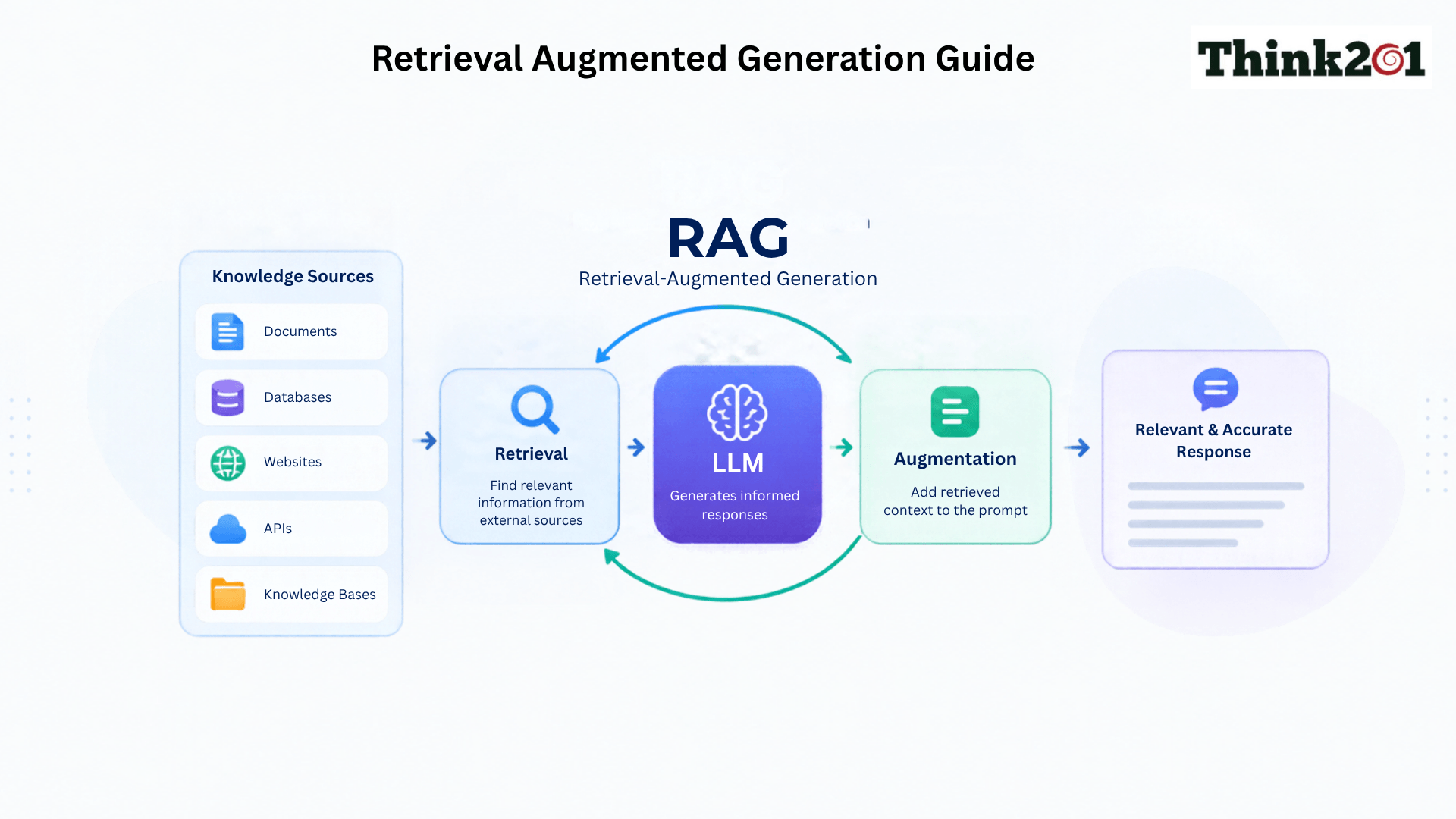
Generative AI can answer questions, summarize information, create content, and support business tasks. Large language models do not automatically know an organization’s latest private information. They can also produce answers without the right context.
This is where Retrieval-Augmented Generation (RAG) becomes useful.
So what is RAG in AI? In terms, RAG is an approach that connects an AI model with external knowledge sources. Instead of relying only on what the model learned during training, the system retrieves relevant information when a user asks a question. It then provides that information to the model as context before generating a response.
This makes RAG particularly useful for business applications that need domain-specific or private information.
What Is RAG in AI?
RAG stands for Retrieval-Augmented Generation. It combines information retrieval with AI.
A traditional large language model generates responses based on patterns learned during training. RAG adds another step. It searches a knowledge source for information relevant to the user’s question and gives that information to the LLM before it generates an answer.
For example, imagine an employee asks an AI assistant, “What is our current work-from-home policy?”
Without RAG, the model may not know the company’s policy. With RAG, the application can search the company’s policy documents, retrieve the section, and provide it to the LLM. The model can then generate an answer based on that retrieved context.
RAG can work with types of information including documents, databases, spreadsheets, knowledge bases, and other enterprise sources.
Why Is RAG Important for Generative AI?
One of the challenges with generative AI is that a model may not have access to an organization’s latest information.
Businesses constantly update product details, policies, pricing, technical documentation, customer records, and internal processes. Retraining a model every time this information changes can be expensive and difficult to maintain.
RAG provides another approach. Instead of changing the model itself, the application can retrieve current information from an external source when the user asks a question.
RAG can also help reduce hallucinations by grounding the model with relevant information. However, it does not guarantee that every response will be correct. The quality of the answer still depends on the quality of the retrieved information, retrieval process, prompts, model, and application controls.
How Does Retrieval-Augmented Generation Work?
A typical RAG system has two workflows.
The first. Indexes the knowledge. The second handles a user’s question. Retrieves relevant information before generating the response.
1. Prepare Data
The process starts by identifying the information the AI application needs to access.
This could include PDFs, Word documents, product manuals, FAQs, websites, spreadsheets, support tickets, source code, databases, or internal knowledge bases.
The data needs to be cleaned and standardized before it enters the RAG pipeline. Duplicate, outdated, irrelevant, or poorly structured information can reduce retrieval quality.
2. Split Content Into Chunks
Documents are usually divided into smaller sections called chunks.
For example, a 50-page employee handbook may be divided into sections based on headings, paragraphs, or other logical boundaries.
Chunking helps the system retrieve the relevant part of a document instead of sending the entire document to the LLM. Poor chunking, however, can separate information and reduce retrieval accuracy.
3. Create Embeddings
The chunks are converted into representations called embeddings.
Embeddings capture the meaning of the content. This allows the system to compare the meaning of a user’s query with stored content rather than relying only on exact keyword matches.
For example, a user might ask, “How many days can I work remotely?” while the document uses the phrase “remote working allowance.” Semantic retrieval can help connect these related concepts.
4. Store the Information
The embeddings and related information are stored in a knowledge store. Vector databases are commonly used for this purpose.
Examples include ChromaDB, Pinecone, and Weaviate. Other systems can also support vector search depending on the application’s architecture and requirements.
Metadata is also important. Information such as document title, date, department, product version, permissions, and source can help the system filter and retrieve more relevant content.
5. Retrieve Relevant Information
When a user enters a question, the system converts the query into a form that can be searched against the knowledge store.
The retrieval component then identifies content.
A RAG application may use vector search, keyword search, or a combination of both. Hybrid search can be particularly useful when documents contain terms, product codes, acronyms, or other exact-match information that semantic search alone may miss.
6. Add Retrieved Context to the Prompt
The relevant content is then added to the user’s question as additional context.
The LLM receives this enriched prompt. Uses the retrieved information when generating its response.
This is the idea behind retrieval-augmented generation: retrieve useful information first, then generate an answer using that information.
7. Generate and Evaluate the Response
Finally, the LLM generates a response using the user’s question and retrieved context.
A production RAG system should also evaluate response quality. Teams can test whether answers are relevant, grounded in retrieved information, and consistent. Ongoing monitoring is important because both the underlying data and user questions can change over time.
Key Components of a RAG Architecture
A RAG architecture usually includes several connected components:
- Data sources: Documents, databases, websites, APIs, knowledge bases, or business systems.
- Data processing: Cleaning, normalization, deduplication, chunking, and metadata creation.
- Embedding model: Converts content and queries into representations for semantic retrieval.
- Vector database or Knowledge store: Stores embeddings and associated metadata.
- Retrieval system: Finds information using vector, keyword, or hybrid search.
- LLM: Uses the retrieved context to generate the response.
- Application layer: Connects the RAG system to the chatbot, website, internal tool, or business workflow.
The exact technology stack can vary. Research and implementation guides commonly discuss tools such as LangChain, LlamaIndex, vector databases, embedding models, and open-source or commercial LLMs as possible components.
RAG vs Fine-Tuning
One question in AI development is whether a business should use RAG or fine-tune an AI model.
The two approaches solve problems.
RAG retrieves information at the time of the query. This makes it useful when information changes regularly or when the application needs answers based on documents and sources.
Fine-tuning changes how a model behaves by training it on examples. It can be useful for tasks such as adapting response style, formatting, or specialized behavior.
For example, a company could tune a model to respond in a specific brand voice while using RAG to provide current product information.
RAG is often easier to maintain when business knowledge changes frequently because teams can update or re-index the data instead of retraining the model.
The right choice depends on the application. In some cases, combining both approaches can provide results.
What Are the Benefits of RAG?
RAG can provide practical benefits for businesses building generative AI applications.
Access to Current Information
RAG can retrieve information from sources that are updated independently of the model. This makes it useful for policies, product information, technical documentation, and other changing content.
Business-Specific Knowledge
Businesses can connect AI applications to their documents and systems. This allows the application to answer questions using information that may not have been part of the model’s training data.
Better Context
Instead of asking an LLM to answer from general knowledge alone, RAG provides relevant context before generation. This can make responses more specific to the user’s question.
Easier Knowledge Updates
When documents change, teams can update the knowledge source and re-index the content. They do not necessarily need to retrain the language model.
Greater Transparency
RAG systems can be designed to retain information about the sources used during retrieval. Applications can then provide citations or references with responses, making it easier for users to verify information.
Common RAG Use Cases
RAG can support business applications where users need answers based on specific knowledge.
Customer Support
A RAG-powered support assistant can retrieve product manuals, FAQs, release notes, and known issue documentation before answering customer questions.
This can help support teams provide relevant responses while keeping answers connected to current product information.
Internal Knowledge Assistants
Employees often spend time searching through HR policies, technical documents, project files, and standard operating procedures.
A RAG assistant allows employees to ask questions in natural language and retrieve relevant information from approved internal sources.
Software Development
Developers can connect RAG systems to code repositories, technical documentation, issue trackers, and internal development guidelines.
The system can then retrieve code or documentation when developers ask technical questions. HCLTech’s practical RAG example demonstrates how source code can be ingested, chunked, embedded, indexed, and retrieved for this type of application.
Legal and Compliance
Organizations can use RAG to search policies, regulations, contracts, and compliance documentation.
Access controls are especially important in these applications because the system may handle sensitive information.
Sales and Marketing
RAG can combine product documentation with customer or campaign information to support recommendations and sales assistance. Enterprise use cases described by K2view include customer service, sales and marketing, compliance, and risk-related applications.
What Are the Challenges of RAG?
RAG is not simply a matter of connecting a vector database to an LLM.
The quality of the underlying data is critical. If the knowledge base contains incorrect information, the application may retrieve that information and produce an unreliable answer.
Chunking is another challenge. Chunks that are too large can include irrelevant information, while chunks that are too small can miss important context.
Retrieval quality also matters. An advanced LLM cannot make up for irrelevant context.
Security needs attention as well. A RAG system should not bring information that a certain user is not allowed to see. Metadata and permission controls can help make sure these rules are followed.
Finally, businesses need to keep an eye on cost and performance. Embedding vector searches, retrieved context, and LLM output all add up to the operating cost of a RAG application.
How to Build a RAG Application
A practical RAG project should start with a clearly defined business problem.
First, identify what users need to ask and which sources contain the answers. Then evaluate the quality, structure, freshness, and permissions of that data.
Next, prepare the content through cleaning, chunking, embedding, and indexing. Choose a retrieval strategy based on the type of information being searched.
After that, select an appropriate LLM and connect the retrieval layer to the generation layer. Prompt design should clearly explain how the model should use the retrieved context.
Testing should happen before and after deployment. Create representative questions and check whether the system retrieves the right information and produces grounded answers.
Finally, monitor the application continuously. Update documents, refresh indexes, evaluate retrieval quality, and review user feedback as the system evolves. A practical RAG pipeline therefore involves both an offline indexing process and an online retrieval-and-generation process.
How an AI Development Company Can Help
Building a production-ready RAG application requires more than choosing an LLM.
An AI development company can help businesses define the use case, prepare enterprise data, select embedding and retrieval strategies, integrate vector databases, connect LLMs, build application workflows, and establish evaluation and security controls.
The development team also needs to decide whether the application requires simple vector retrieval, hybrid search, reranking, multiple retrieval steps, or a more advanced architecture.
The best approach depends on the business problem rather than the number of technologies included in the system.
What Is the Future of RAG?
RAG is becoming an important part of modern artificial intelligence because it provides a practical way to connect generative models with external knowledge.
Simple RAG systems can retrieve information from a small collection of documents. More advanced architectures can combine hybrid retrieval, reranking, knowledge graphs, multi-step retrieval, or AI agents for more complex tasks.
The direction a business takes should depend on its requirements. A small internal knowledge assistant may not need a complex architecture. A large enterprise application with multiple data sources, strict permissions, and complex queries may require more advanced retrieval and governance.
The goal should remain the same: provide the AI application with the right information at the right time and generate a useful response from that context.
Final Thoughts
Retrieval-Augmented Generation gives businesses a practical way to connect generative AI with their own knowledge and data. By retrieving relevant information before generating a response, RAG can make AI applications more contextual and useful for business-specific tasks.
However, successful RAG implementation depends on more than the LLM. Data quality, chunking, embeddings, retrieval, security, evaluation, and application architecture all play important roles.
For businesses exploring AI development, RAG can be a valuable approach for building knowledge assistants, customer support systems, intelligent search experiences, and other AI-powered applications. Think201 can help you evaluate your use case, choose the right technology stack, and build practical AI solutions around your business requirements.
Ready to explore RAG for your business? Contact Think201 to discuss your AI development requirements.
Frequently Asked Questions
What Are the 7 Types of RAG?
There is no one list that everyone agrees on for seven types of RAG. Different setups group RAG systems in ways based on how they get information, how they are set up, and how complex they are. Common ways include:
- Naive RAG – Uses document retrieval followed by generating a response.
- Advanced RAG – Makes retrieval better with things like ways to split the information, making the question clearer, filtering, and sorting again.
- Modular RAG – Uses parts that can be swapped out for retrieval, processing, making a response, and other tasks.
- Hybrid RAG – Mixes searching by meaning with searching by words.
- Graph RAG – Uses knowledge graphs to find how different things and ideas are connected.
- Conversational RAG – Uses conversations to make retrieval better when the conversation goes back and forth.
- Agentic RAG – Uses AI agents to plan the steps for getting information, use tools, and do complex steps to search.
These categories can mix, so one RAG system might use more than one method.
What Are the Five Stages of a RAG System?
A normal RAG process can be split into five steps:
- Data preparation – Gather, clean, and arrange documents or other knowledge sources.
- Indexing – Break content into pieces and make embeddings. Put them into a database that can be searched.
- Query processing – Deal with the user’s question and make it ready for the search.
- Retrieval and adding information – Find the information and add it to the question as background.
- Generation and checking – The LLM makes an answer using the information that was found, which can then be checked for how good it is
The number of steps can change depending on how the RAG system is built.
What Is LLM vs RAG?
An LLM is an AI model that deals with and generates language. It can answer questions, summarize text, write text, make code, and do other language-based tasks.
RAG is a method that connects an LLM to knowledge. It finds information and gives that to the LLM before making a response.
In short, the LLM creates the answer while RAG gives the LLM the information it needs to answer.
Why Do We Need RAG for LLMs?
LLMs have limits when they need to get up-to-date, very specific information. Their built-in knowledge might not include the company documents, rules, product details, or internal data.
RAG helps by finding the information from outside sources when the question is asked. This lets companies make AI tools that can use their information without having to retrain the whole LLM every time the information changes.
RAG can be really helpful for customer help, internal knowledge assistants searching documents, technical help, and other AI projects.
Does RAG eliminate AI mistakes?
No. RAG can help ground responses in relevant external information, but it does not guarantee that every answer will be correct. Retrieval quality, source quality, model behavior, prompting, and evaluation all affect the final result.
Sources Referred
https://www.k2view.com/what-is-retrieval-augmented-generation
https://www.hcltech.com/blogs/retrieval-augmented-generation-rag-guide